
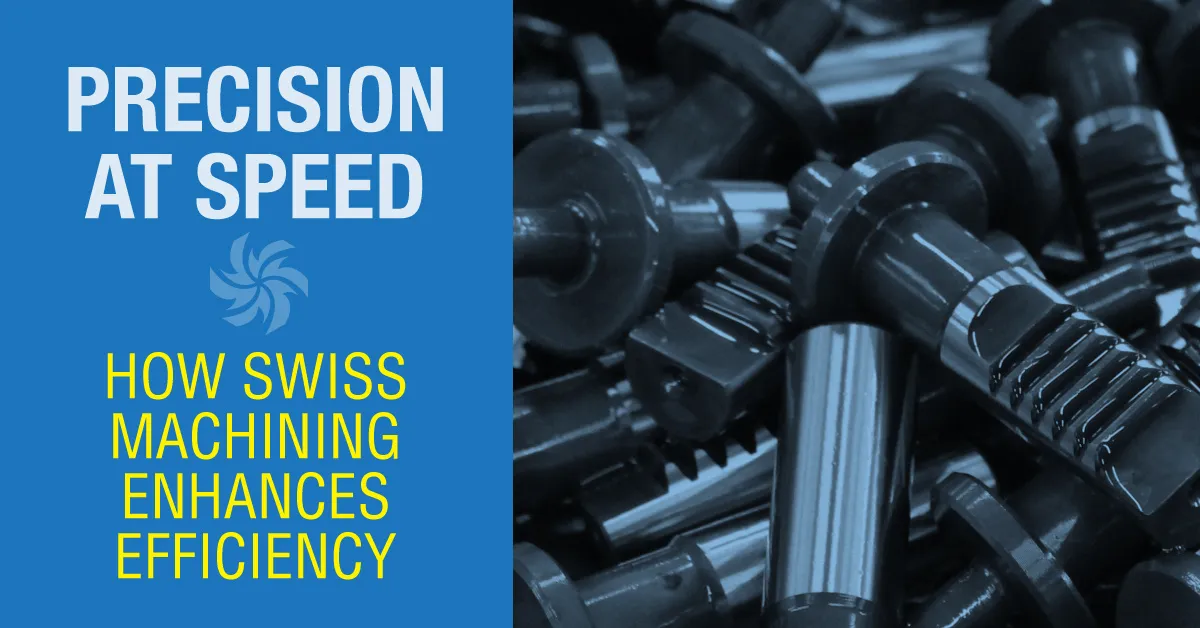
Swiss machining delivers tight tolerances at rapid cycle times, making it a proven method for high-volume, complex, and thin components. This article explains how Swiss machining enhances efficiency across setup, cycle time, quality, and total cost. You will learn where Swiss excels, what drives its speed and precision, and how to leverage it for reliable, repeatable production.
At Cass Precision Machining, we focus on practical outcomes: shorter lead times, fewer secondary operations, and consistent quality. Along the way, we highlight applications common to our customers—components for medical devices, industrial controls, and consumer products—where reliability and throughput matter.
Reduced Cycle Time Through Sliding-Headstock Control
Swiss machines use a sliding headstock that feeds bar stock through a guide bushing, supporting the workpiece close to the cutting tool. This configuration cuts deflection and enables aggressive, stable cuts at speed. Parts with long length-to-diameter ratios that would chatter on conventional lathes run smoothly on a Swiss platform, reducing cycle time and scraps.
Tooling layouts are compact and coordinated. Live tooling, multi-axis motion, and simultaneous operations allow roughing, finishing, drilling, milling, and threading in one pass. For many geometries, sub-spindle pickup completes backworking while the main spindle starts the next part—keeping the spindle cutting more of the time. The result is faster throughput without sacrificing tight tolerances, often down to ±0.0002 inch, depending on material and features.
Fewer Setups, Fewer Secondary Operations
Efficiency improves when you remove handoffs. Swiss machining consolidates operations into a single, stable setup. Features such as cross-holes, flats, slots, knurling, and internal threads can be produced in one machine cycle. This reduces fixture changes, inspection transfers, and queue time between departments.
For example, a fluid control pin that formerly required turning, then milling, then tapping can be produced completely from a bar on a Swiss machine. When parts leave the machine finished or near-finished, you cut lead time, inventory buildup, and the risk of damage between steps. In many cases, post-processing is limited to washing, deburring, and simple finishing, further compressing the schedule and cost.
Superior Precision for Small & Complex Parts
Swiss machining’s hallmark is precision on small-diameter and complex parts. The guide bushing supports the workpiece within millimeters of the tool, enabling reliable control over thin walls, micro-features, and deep, small-diameter holes. Tight concentricity between turned and milled features is achievable because the part is never unclamped during the cycle.
Repeatability is equally strong. With bar-fed automation, dimensional control from the first part to the ten-thousandth part is consistent. This matters in medical and instrumentation applications where mating components must assemble smoothly every time. Stable processes reduce variability, which lowers inspection burden and rework rates and supports reliable on-time delivery.
Material Versatility & Scalable Production
Swiss platforms process a wide range of materials—aluminum, brass, carbon and alloy steels, stainless steels including 300/400 series, and select nickel alloys—each with tuned parameters to balance tool life and speed. Chip control features and high-pressure coolant options maintain surface finish and edge quality at higher removal rates.
Automation scales production without constant operator intervention. Bar feeders keep the spindle cutting; parts catchers and conveyors manage output. For new designs, rapid prototyping and short pilot runs on Swiss equipment build confidence in manufacturability before scaling. When demand increases, programs, tooling, and validated process windows allow for fast ramp-up, maintaining quality as volumes grow.
Frequently Asked Questions About Swiss Machining
What types of parts are best suited for Swiss machining?
Swiss machining is ideal for small-diameter, long, or thin components that require tight tolerances and multiple features produced in one cycle. Examples include shafts, pins, valve components, and precision fasteners. Parts with complex geometries—cross-holes, flats, milled features, and internal/external threads—benefit from the multi-axis, simultaneous capability of Swiss machines.
How does Swiss machining improve total cost compared to conventional turning?
Although hourly machine rates can be higher, Swiss machining often lowers total cost by reducing cycle time, eliminating secondary operations, decreasing scrap, and compressing lead time. One-and-done setups reduce handling and inspection steps. Stable processes maintain tight tolerances and repeatability, which minimizes rework and supports reliable, on-time delivery over large production runs.
We are Cass Precision Machining, a trusted partner for precision-machined parts since 1945. We serve OEMs and manufacturers that need dependable quality, responsive support, and on-time delivery across prototype, pilot, and production volumes. To discuss your project or request a quote, please contact us.